
Choosing Your Satellite Mode
Every COROS device supports multiple satellite modes. This guide walks through the purpose of each mode and the conditions where it performs best, so you can match your setup to the activity ahead of you.
To change the satellite mode on COROS watches, long press the Back button to open Control Center, then select Satellite Mode. (The options that are available on your device may not include all of the satellite modes listed below. This is normal; options may differ between watch models.)
On COROS DURA, go to System → More Settings → Satellite Systems.
All Systems On (High)
Available on COROS PACE 3, PACE 4, PACE 4 Pro, PACE Pro, COROS NOMAD, APEX 2, APEX 2 Pro, APEX 4, VERTIX 2, VERTIX 2S, DURA.
This is the recommended satellite mode for most scenarios. This mode activates the five major satellite systems simultaneously: GPS, GLONASS, Galileo, Beidou, and QZSS. This gives your watch the widest possible pool of signals to draw from at any given moment.
Best for: Most training situations you'll encounter, including suburban streets, open terrain with a clear view of the sky, and shaded trails where tree cover partially blocks signal. Because it draws on every system available, All Systems On delivers strong, consistent accuracy while still managing battery, which is why it's the mode we recommend for the majority of everyday workouts.
Dual Frequency (Max)
Available on COROS PACE 3, PACE 4, PACE 4 Pro, PACE Pro, COROS NOMAD, APEX 2 Pro, APEX 4, VERTIX 2, VERTIX 2S, DURA.
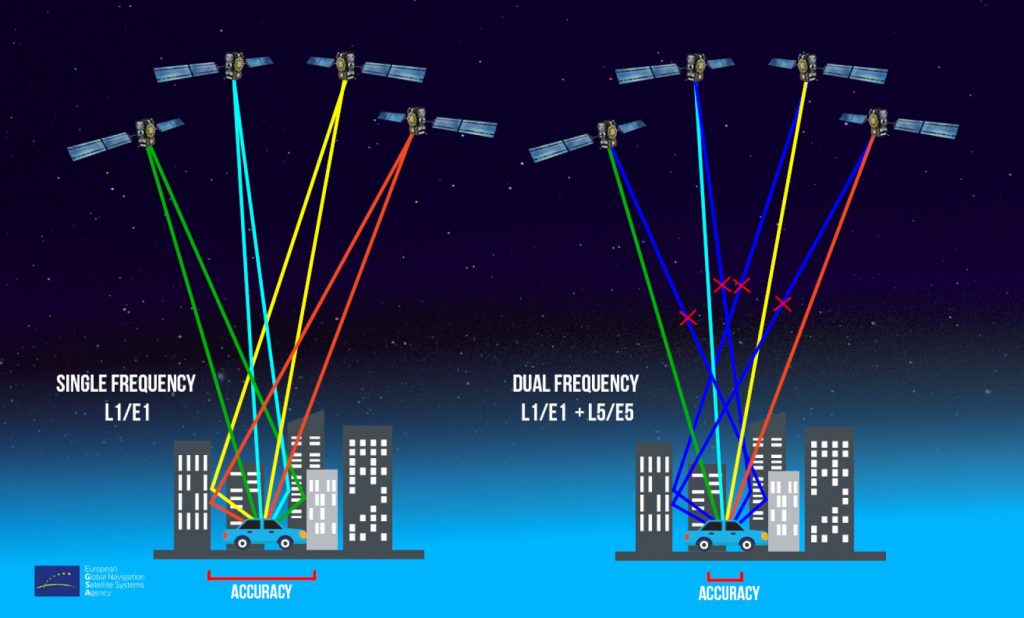
Dual Frequency is the most accurate satellite mode COROS offers. Rather than relying on a single frequency band, the watch communicates with satellites across two frequencies at once, allowing it to filter out signal interference and maintain precision even in difficult environments.
Best for: Environments where GPS signal is difficult to acquire or hold, such as dense urban areas surrounded by tall buildings, deep canyons with limited sky exposure, or heavily forested terrain. This level of accuracy requires meaningfully more power than the other modes, so it's worth reserving for situations where precision matters more than battery life.
Auto Mode
Available on PACE 4 Pro and DURA.
Auto Mode primarily relies on Dual Frequency (Max) to ensure the strongest satellite signal, but intelligently switches to All Systems (High) depending on the GPS conditions of your location. This yields some battery life savings while maintaining accuracy.
Best for: Scenarios where you need a few extra hours of battery, without sacrificing GPS accuracy.
Endurance Mode
Available on COROS NOMAD and APEX 4.
Endurance Mode also draws on all available satellite systems, but instead of running them continuously, it works intelligently in the background to identify which signals are strongest at any given moment, and only activating those.
Best for: Long-duration efforts where you still need dependable GPS accuracy, but also need to conserve battery life as much as possible.
Standard GPS
Available on COROS PACE 2, PACE 3, APEX 42mm, APEX 46mm, APEX Pro 1, APEX 2, APEX 2 Pro, VERTIX 1, VERTIX 2, VERTIX 2S.
Standard GPS performs reliably in areas with excellent sky visibility and strong reception, but its accuracy drops off in conditions where signal is harder to maintain - such as trees, tall buildings, and canyons. It is only recommended to use this mode when preserving battery life is crucial.
Best for: Situations where conserving battery is the priority.
Contact COROS Support
Need help or have additional questions? Reach out to a COROS Expert in one of the following ways:
- Submit a Support Request Form – Click here to get started
- Send a message via the COROS App:
- Open the COROS App
- Go to Profile Page > Customer Support > Contact Support > Submit.